
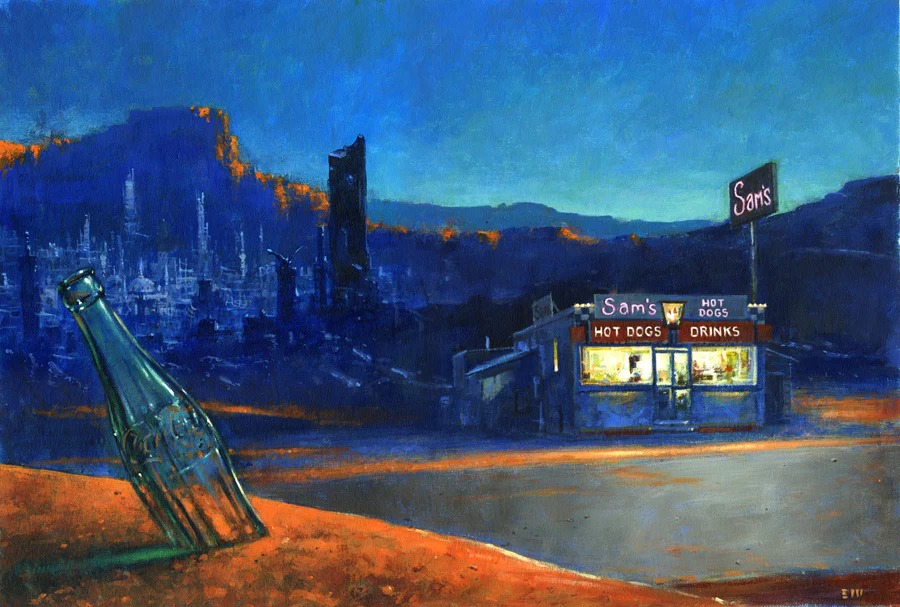
The Martian Chronicles by Ray Bradbury (1994) was all over the place. I’m usually not a fan of a story that is a collection of mini-stories with different characters in each one, but this one managed to pull it off pretty well. What I love the most about books like this is that it is science fiction from the past. It depicts a world where we are mechanically advanced, but electronics haven’t gotten that far. Despite being able to travel to Mars, the most communication was done either via land-line telephones or via Radio.
The end premise of the book relies upon a wild assumption that once an atomic war breaks out on Earth, EVERYONE except for maybe a dozen people on Mars packs up and heads back to Earth to fight in the war?!? Isn’t that a crazy idea. If I heard that a nuclear war broke out between all the major countries, the last place I would head is to that planet. I would hunker down and stay right at Mars. A lot of novels by Ray Bradbury and Kurt Vonnegut have these types of non-nonsensical assumptions about how humans would behave in certain unknown situations. Maybe they are trying to be interesting, or maybe they are making a point on human nature, on how even if you leave to go to another planet, you would still have strong feelings for Earth.
There were three quotes I really enjoyed in the book.
The Martians discovered the secret of life among animals. The animal does not question life. It lives. Its very reason for living is life; it enjoys and relishes life.
This was spoken by Spender to Captain Wilder after he kills several other astronauts. Spender discovered the beauty of the martian society and didn’t want humans to come in and destroy all their culture. It also speaks to the nature of how the Martians were depicted. They were telepathic, and seemed to be more in-tune with nature and all that.
I think they all guessed but didn’t question. You don’t question Providence. If you can’t have the reality, a dream is just as good
This was a quote in the chapter where A martian was “adopted” by a family after he takes the form of their dead son. Martians in this book were able to shape-shift into what the other person desired to see the most. Despite knowing that it’s not real, at several points throughout the book, humans play along giving themselves the allusion of seeing their lost loved ones again.
Life on earth never settled down to doing anything very good. Science ran too far ahead of us too quickly, and people got lost in a mechanical wilderness, like children making over petty things, gadgets, helicopters, rockets; emphasizing the wrong items, emphasizing machines instead of how to run the machines. Wars got bigger and bigger and finally killed earth.
This was in the final chapter of the book. Shortly after war broke out on earth, a single family had the sanity of mind to leave earth and go to Mars (after everyone on Mars left and went to Earth). The father was telling his son how terrible earth was while burning all the Earth magazines in a heap of fire. He wanted his sons to not make the same mistakes that we made on earth. This quote runs parallel to Kurt Vonnegut’s book Player Piano. Even in the 40’s and 50’s there was a feeling that technology was moving too fast for us to do good with. Bradbury was referring to the creation of all the new weapons used in WWII, but a modern reading of this could draw parallels to AI.